
Outdoor living spaces aren’t just for summer anymore. Especially since the pandemic, people have been waking up to the beauty and serenity that are waiting for them, literally in their own backyards. An intimate gathering around the fire pit is the perfect end to a summer dinner party, and it can serve as the social anchor of the backyard even when it’s not in active use. But if you have the right one, it can also keep you actually warm for an evening kickback, even in the winter.
A custom outdoor fire feature built to your space’s specifications feels like it grew there organically, like your favorite tree. That beauty, combined with how much real warmth it provides, can even raise the value of your house.
Key Takeaways
- Purpose drives design. How you’ll actually use the fire pit determines its size, shape, and placement.
- Material and fuel choice shape upkeep. Steel, stone, and concrete each carry different maintenance, and gas features skip the smoke and burn-ban restrictions that come with wood.
- Safety comes before aesthetics. Real clearance, fire-resistant surroundings, and code compliance matter more than how a fire pit looks.
- Custom fabrication holds up longer than mass-produced fire pits and comes backed by a lifetime warranty.
Why a Custom Fire Pit Creates a Better Outdoor Living Experience
A custom fire pit changes how a backyard functions, not just how it looks. It determines the layout for what surrounds it: where the seating goes, where people naturally walk, where the eye lands first. That kind of intentional design is what separates a finished-feeling backyard from one that feels more makeshift.
Personalized designs also integrate with what’s already in place. A fire pit built to the actual proportions of a patio, pool deck, or outdoor kitchen looks like it really belongs to that space instead of trying to squeeze in later.
And the value isn’t only visual. A gorgeous fire pit can make people want to linger outside instead of drifting back in after dinner.
Start with the Purpose Before Choosing a Design
| Purpose | Design Considerations |
|---|---|
| Family gathering space | Larger seating radius, comfortable access, child-safe layout |
| Outdoor entertaining | Conversation-friendly arrangement, integrated lighting, beverage tables |
| Luxury landscape centerpiece | Sculptural design, premium materials, architectural integration |
| Poolside feature | Wind management, reflective lighting, modern styling |
| Commercial hospitality | Durability, ADA accessibility, high-capacity seating, weather resistance |
Before you choose a shape or a material, define how the fire pit will actually get used. For example, a gathering space for a family needs a wider seating radius and a layout kids can move through safely.
Top 4 Custom Fire Pit Ideas for Every Outdoor Style
Every outdoor style calls for a different kind of fire feature. Here are four approaches we build often, and you can see finished examples of each in our project gallery.
Modern Minimalist Fire Pits
For homeowners searching for custom metal fire pit ideas, this is usually the starting point: corten steel, black steel, or poured concrete, often combined in the same piece. The straight edges and restrained material palette read as an extension of contemporary architecture.
Rustic Mountain Retreat Designs
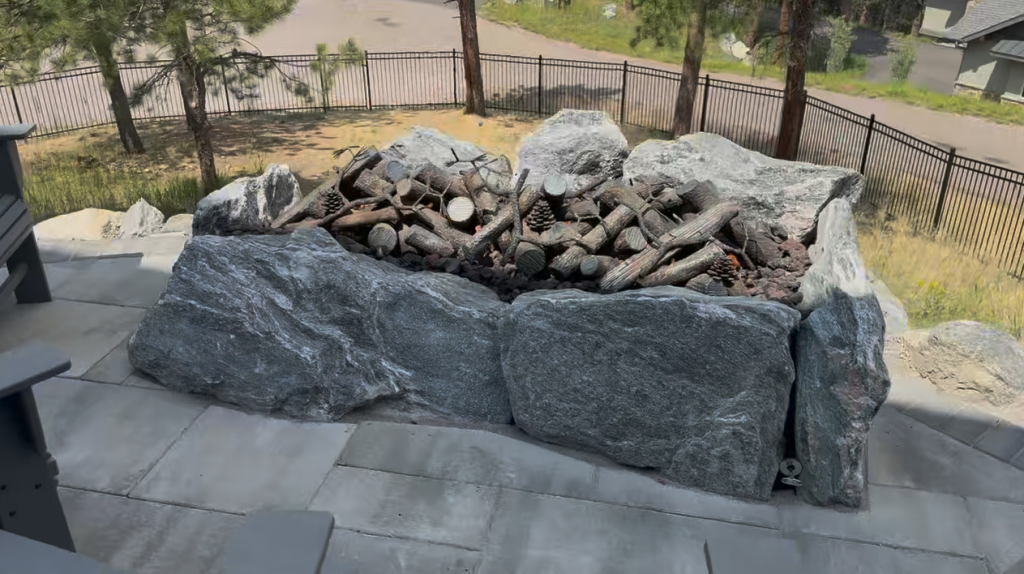
Rustic mountain retreat designs use natural stone, weathered steel, and timber seating built for texture over polish. These pair naturally with cabins and ski chalets. We fabricate the steel elements in our Breckenridge shop, so the weathering process starts exactly where the piece will live.
Luxury Resort-Inspired Fire Features
Luxury resort-inspired fire features run larger: oversized linear burners, fire and water combinations, and built-in seating sized for a crowd. These pieces are meant to be seen from across the yard and hold their own against premium materials already in place.
Traditional Backyard Gathering Spaces
Traditional backyard gathering spaces keep things simple: a circular layout, a classic stone surround, timeless seating that doesn’t chase a trend. This approach works across nearly every home style, which is why it remains one of the most requested custom fire pit designs we build.
Choosing the Best Shape for Your Custom Fire Pit
For homeowners chasing modern fire pit ideas, shape is often where the design starts, since it changes how a group interacts around the fire and how the piece reads within the surrounding landscape design.
| Shape | Best For | Design Advantages |
|---|---|---|
| Round | Social gatherings | Encourages conversation and equal seating |
| Square | Modern patios | Symmetrical appearance and efficient layout |
| Rectangle | Contemporary landscapes | Creates dramatic focal points and larger flame display |
| Linear | Outdoor kitchens & pools | Defines entertainment zones and luxury aesthetics |
| Freeform | Natural landscapes | Organic integration with gardens and irregular patios |
Material Options That Define the Overall Look
The material carries most of the visual weight in outdoor fire pit designs, and it’s usually the first decision that shapes everything else.
Steel Fire Pits
Handcrafted steel can be cut, bent, and welded into almost any geometry, which is why it’s behind most of our sculptural and architectural pieces. Left untreated, weathering steel develops a protective rust patina that shields the metal from further corrosion, so the material gets more distinctive with age instead of wearing out.

Stone and Masonry
Stone and masonry bring permanence and a look that doesn’t shift with trends. Natural stone reads as though it’s always belonged on the property, and it pairs naturally with pavers, retaining walls, or in-ground fire features built directly into a patio surface.
Concrete Designs
Concrete gives us the most control over color and form. Poured or precast, it holds clean minimalist lines and takes finishes from smooth and pale to textured and dark.
Mixed Materials
Steel and stone, or concrete and wood seating, create visual depth a single material can’t produce alone. These combinations are common in our larger, sculptural commissions.
Gas vs. Wood-Burning Fire Pits
Fuel type changes the daily experience of owning a fire pit, not just the installation.
| Feature | Gas Fire Pit | Wood Fire Pit |
|---|---|---|
| Convenience | High | Moderate |
| Maintenance | Low | Higher |
| Smoke | Minimal | Significant |
| Ambiance | Clean modern flame | Traditional crackling fire |
| Heat Output | Consistent | Variable |
| Installation | Requires gas connection | Simpler but requires clearance |
| Best For | Luxury outdoor living | Rustic entertainment spaces |
Colorado’s fire bans are part of why our company exists in the first place. We’re not talking about a smoky wood fire or, on the other end of the spectrum, a merely decorative flame. Gas features like these produce real radiant heat and stay legal during most burn bans, since they don’t burn wood and don’t produce smoke.
Design Features That Make a Custom Fire Pit Stand Out
Built-In Seating
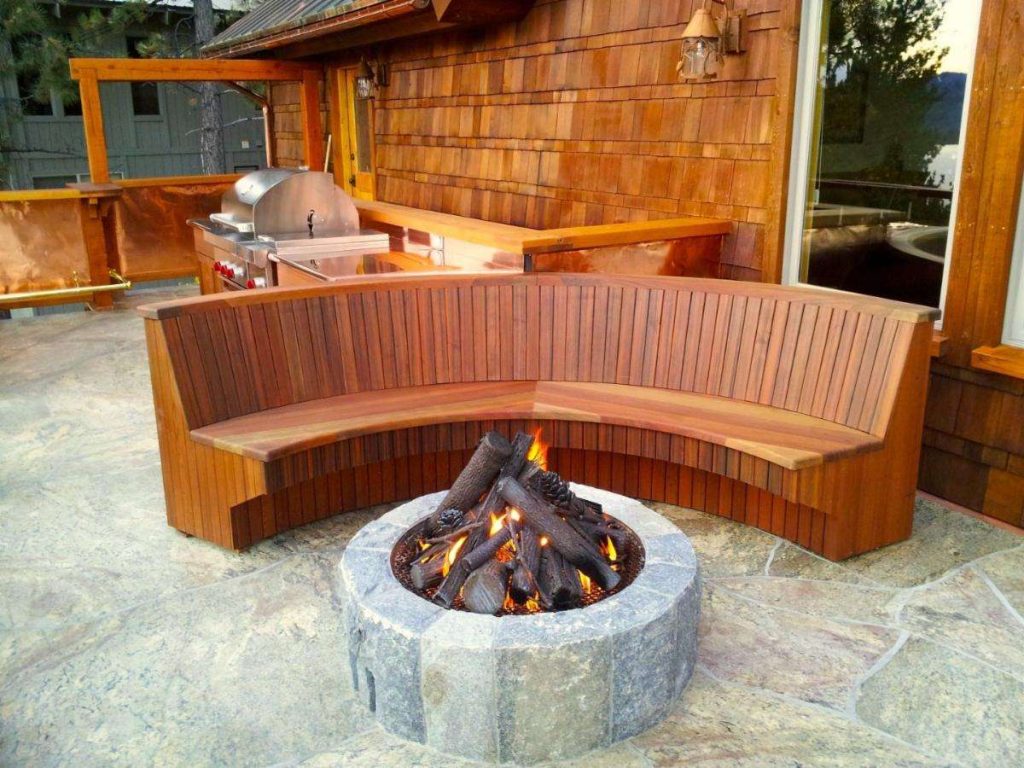
Built-in seating turns a backyard with a fire pit into an entire outdoor room. Curved benches are a nice touch to keep a group facing the fire and each other, while sectional layouts give more flexibility for larger gatherings.
Fire and Water Combinations
Fire and water combinations pair a fire feature with a fountain or a pool edge, and the contrast between the two can be striking. These builds lean toward luxury landscapes, where the extra engineering pays off with a nighttime look that’s hard to achieve with fire alone.
Decorative Fire Media
Lava rock and fire glass both catch light differently than steel log media, and ceramic logs read as closer to a traditional wood fire without the smoke. We help clients choose media based on the look they want and the burner style underneath it.
Integrated Lighting
Layered outdoor lighting extends a fire feature’s usefulness after the flame goes out. Path lighting, uplighting on nearby plantings, and low-voltage fixtures built into seating keep a space usable and safe well into the night.
Safety Considerations You Should Never Overlook
Every custom fire pit needs real clearance from structures, decks, fences, and overhanging branches, along with ventilation and fire-resistant materials immediately around it. Fire-safety guidance calls for outdoor fires to stay at least 10 feet from your home or anything that can burn, and that distance is a floor, not a target.
Child and pet safety comes down to sightlines and barriers: a fire pit visible from the kitchen or main living space gets supervised more consistently than one tucked around a corner.
Gas fire features need their lines inspected on a routine schedule, the same as any other gas appliance in the home. Working with an experienced fabricator keeps the build in line with local code.
Custom Fire Pit Trends Homeowners Love in 2026
Fireplaces and fire pits are trending together in outdoor renovation data this year, not just in what we’re building in our own shop.
| Trend | Why It’s Popular |
|---|---|
| Oversized linear burners | Luxury appearance and larger entertainment spaces |
| Weathering steel finishes | Low maintenance and natural patina |
| Fire + water combinations | High-end resort aesthetic |
| Integrated smart ignition | Convenience and safety |
| Built-in modular seating | Cohesive outdoor design |
| Multi-functional fire tables | Combines dining and gathering |
| Sculptural steel fire features | Statement architectural pieces |
The Houzz Outdoor Trends Study found that fire features now appear in nearly half of the outdoor lounge areas homeowners are building this year, right alongside sofas and lighting. That lines up with what we’re seeing: more requests for multi-functional fire tables and sculptural steel pieces that double as a landscape’s focal point.
Why Custom Fabrication Delivers Better Long-Term Value
A mass-produced fire pit is built to a spec sheet, not your yard. Custom fabrication starts with your site, your architecture, and your existing materials.
Every piece we build is handcrafted, made-to-order, and fabricated one at a time in our Breckenridge shop. That process costs more up front than buying off a shelf, and it means the artistry, the welds, and the material grade are things we control instead of inheriting them from a factory line.
Custom fabrication also solves problems a standard fire pit can’t: an odd-shaped patio, a slope, a specific sightline you want preserved. If a fire feature is one piece of a larger property plan, we also offer other custom fabrication services to match it.
Every fire feature we build carries a lifetime warranty, which reflects how we build it, not just a promise layered on top. For a lot of our clients, their fire feature ends up outlasting the patio around it and becomes something closer to a family heirloom than a backyard fixture.
Working with a Professional Fire Feature Fabricator
Building a custom fire pit idea into a finished piece starts with a conversation, moves through concept sketches, and ends with fabrication in our Breckenridge shop. We build the design around the dimensions, layout, and how the space actually gets used, based on what you send us, before any steel gets cut.
Structural integrity isn’t optional on a piece that holds an open flame. Our welds follow structural welding standards set by the American Welding Society, the same code used on structural steel projects far larger than a backyard fire feature.
Conclusion
The best custom fire pit balances how it looks, how it holds up, and how it actually gets used. Beauty without durability doesn’t last a Colorado winter, and durability without beauty doesn’t create a space people want to spend their evenings in.
You don’t need to know exactly what you want before reaching out. Talk with a fire feature specialist and we’ll help you figure out what fits your space, your style, and how you plan to use it. If you’re planning more than one custom piece, ask about our multi-piece project pricing too.
FAQs
How much space should you leave around a custom fire pit for comfortable seating?
Plan for at least three feet of clear space around the fire pit itself, with seating set back far enough that no one sits within reach of direct radiant heat. For a group of six or more, a 12 to 18 foot diameter gathering area gives people room to move.
Can a custom fire pit be designed to match the architecture of an existing home?
Yes. We match materials, finishes, and proportions to what’s already on the property, so the fire feature reads as part of the home’s design instead of an add-on.
What maintenance does a steel fire pit require throughout the year?
A weathering steel fire pit needs almost no maintenance beyond letting the patina develop naturally. Painted or coated steel needs periodic checks for chips or wear.
Are custom fire pits suitable for high-altitude or windy environments?
Yes, with the right design choices. Wind management, like windscreens or lower-profile burners, keeps flame and smoke under control at altitude, and gas fire features may need adjustment for the thinner air common in mountain settings like Breckenridge.
How early should homeowners plan a custom fire pit during an outdoor renovation project?
As early as possible, ideally before hardscaping begins. Placement affects patio layout, seating, lighting, and gas or electrical lines, so bringing a fire feature into the plan late usually means working around decisions already poured in concrete.